
Purpose-built protection for pharmaceutical and biotech operations
In pharmaceutical and biotech manufacturing, safety systems are a core part of how facilities operate and demonstrate compliance. Operators work alongside pressurized vessels, high-temperature surfaces, and automated equipment on a daily basis, and the safety features built into that equipment directly affect the outcomes of risk assessments, equipment qualification protocols, and OSHA inspections. Facilities operating under cGMP are expected to document hazard controls as part of their validation process, and the safety architecture of a sterilizer contributes to that documentation.
BMT USA cGMP sterilizers are designed with this operational reality in mind, incorporating multiple independent safety systems that address personnel protection, pressure management, temperature control, and ergonomic risk across the full lifecycle of the equipment.
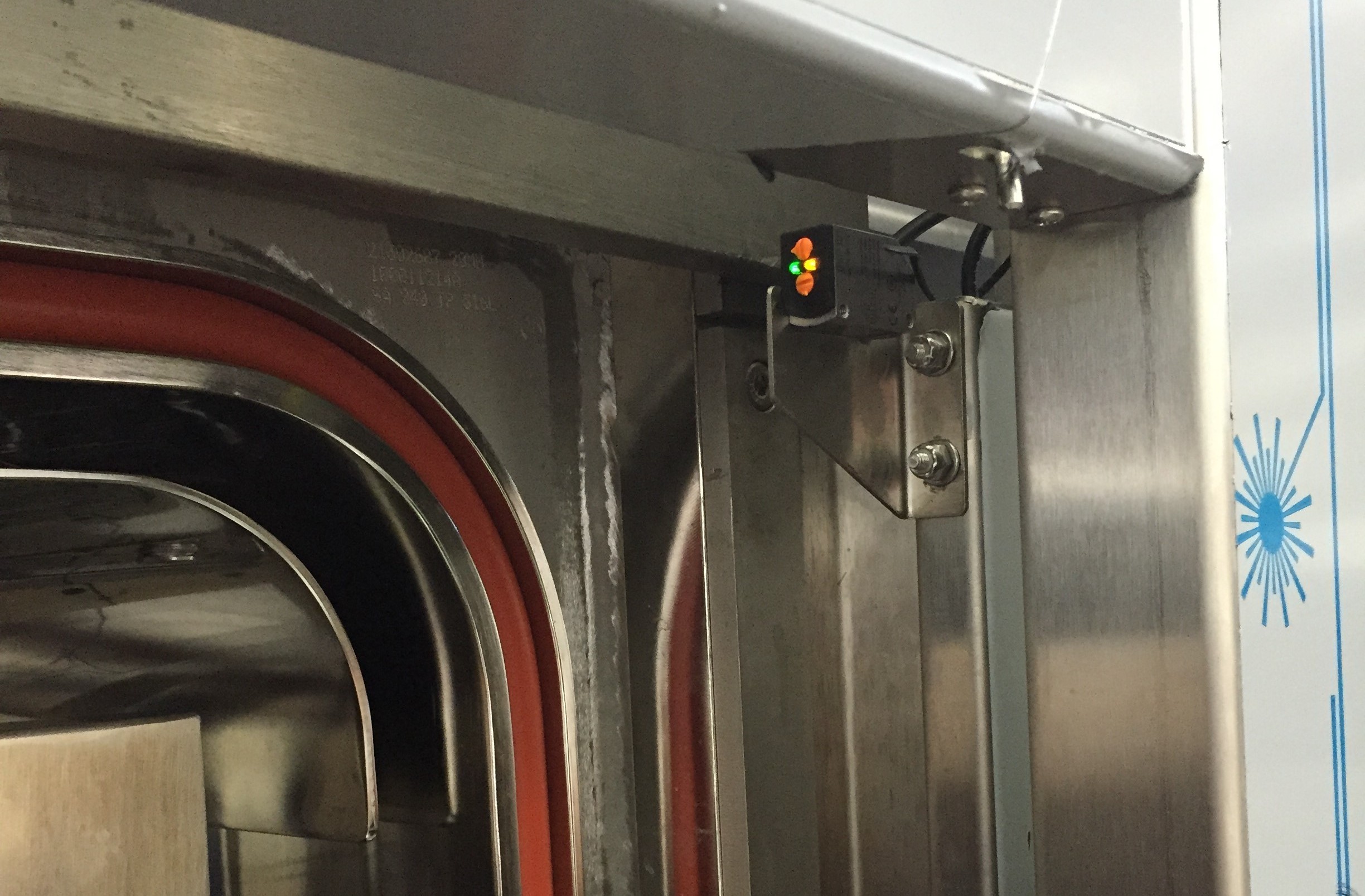
Photoelectric door sensors
Every BMT USA sterilizer ships with photoelectric door sensors as standard equipment. A continuous infrared beam runs between a sensor mounted on the chamber door and a reflector on the opposite panel. Any interruption of that beam while the door is closing, whether from an operator or a loading cart, immediately signals the PLC to stop and reverse the door back to the fully open position. Response is instantaneous, and the system defaults to safe mode if the sensor degrades, meaning protection doesn’t depend on a component being in perfect condition to function.
Traditional spring-loaded contact systems work differently. They only activate after physical force is applied to a contact plate, which means contact has already occurred before the protection engages. Spring tension also varies with wear over time, introducing inconsistency into what should be a predictable safety function.
Alternatively, photoelectric detection removes that sequencing problem entirely. Because the infrared beam is continuous and interruption triggers the response, there is no contact requirement and no mechanical threshold to cross before the door stops. It also eliminates the spring mechanisms, contact plates, and linkages that require regular inspection and adjustment, reducing both maintenance burden and the number of components that can degrade or fail.
Pressure vessel safety
Pressurized vessel operation carries inherent risks, and BMT USA sterilizers address those risks through multiple independent systems rather than relying on any single control. Pressure relief valves prevent dangerous buildup, while door interlocks prevent chamber access during active cycles. The PLC monitors operating conditions continuously and will alarm if parameters drift outside acceptable ranges. Because these systems operate in parallel, no single point of failure compromises overall protection.
Temperature monitoring and control
Accurate temperature control matters for both product quality and personnel safety, and the two are closely related in a sterilization environment. Independent temperature sensors monitor chamber conditions throughout every cycle. If temperatures exceed their configured limits, the control system automatically interrupts the steam supply before product damage or unsafe surface conditions can develop. Controlled cool-down sequences then maintain stable conditions through the end of the cycle, and exterior surfaces remain at safe contact temperatures during normal operation.
Electrical safety and ergonomics
The day-to-day safety of a sterilizer isn’t limited to what happens during a cycle. Emergency stop buttons are accessible from multiple positions around the equipment, and electrical systems are designed to support standard lockout/tagout procedures for maintenance work. Automatic door operation, controls positioned at standard working heights, and a well-organized mechanical space that minimizes awkward reaching or positioning helps reduce the cumulative physical demands on operators and technicians who work with the equipment every day.
Compliance and validation support
The safety architecture in BMT USA sterilizers is designed to support the compliance obligations of regulated pharmaceutical and biotech facilities. Equipment design aligns with OSHA machinery guarding and hazard prevention standards. Safety system records are included in the documentation package shipped with every unit, providing the evidence base needed for process validation and equipment qualification. The organized mechanical spaces that make maintenance safer also reduce the time and documentation burden associated with preventive maintenance procedures.
Engineering safety into the full equipment lifecycle
BMT USA cGMP sterilizers are built around the idea that safety, compliance, and serviceability aren’t separate problems. Photoelectric door sensors, redundant pressure and temperature controls, and thoughtful ergonomic design each address more than one risk at a time, protecting personnel, preserving product integrity, and reducing the maintenance overhead that comes with complex equipment in a regulated environment. For pharmaceutical and biotech facilities where performance has to be demonstrated and maintained over years of production, that level of integration is what separates well-engineered equipment from equipment that simply meets spec.